 跳到内容
跳到内容 






Electronic Universal Testing Machine
High-precision electronic universal testing machines designed for testing the mechanical properties of materials are widely used in laboratories, factories, and quality inspection agencies.
Metal Impact testing machine- -Charpy or izod test at room temperature or low temperature
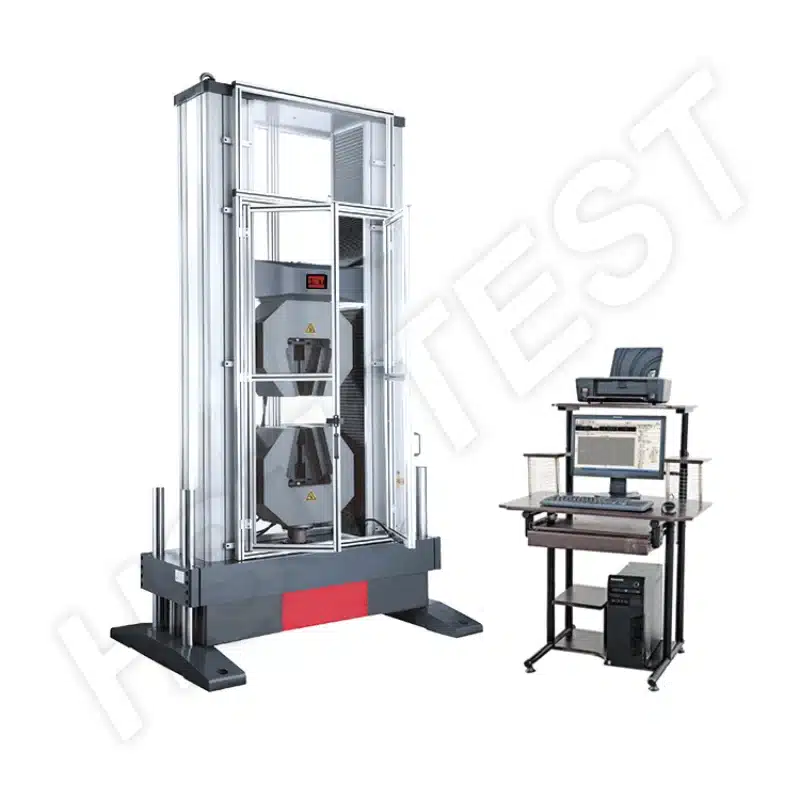
Universal Testing Machine (UTM), also known as an electronic tensile testing machine or electronic universal testing machine, is used to perform tensile, compression, bending, peel, and shear tests on metals, plastics, rubber, composite materials, textiles, and other materials.
The equipment employs a servo motor and ball screw drive system, coupled with a high-precision load cell, to ensure stable and accurate testing.
All models comply with international testing standards such as ASTM, ISO, DIN, and GB, meeting the professional needs of both laboratory and industrial clients.
Experiential Materials Mechanics Testing
Complex testing tasks have never been easier. This video will guide you through our intuitive interface and powerful data analysis software.
Quick Setup: Pre-set test templates for one-click start.
Real-time Visualization: Dynamically track the testing process and automatically generate stress-strain curves.
Safe and Reliable: Equipped with overload protection and automatic limit functions to ensure operator and equipment safety.
Watch the video to see how this UTM significantly improves your testing efficiency while maintaining lab-grade accuracy.
Product Features
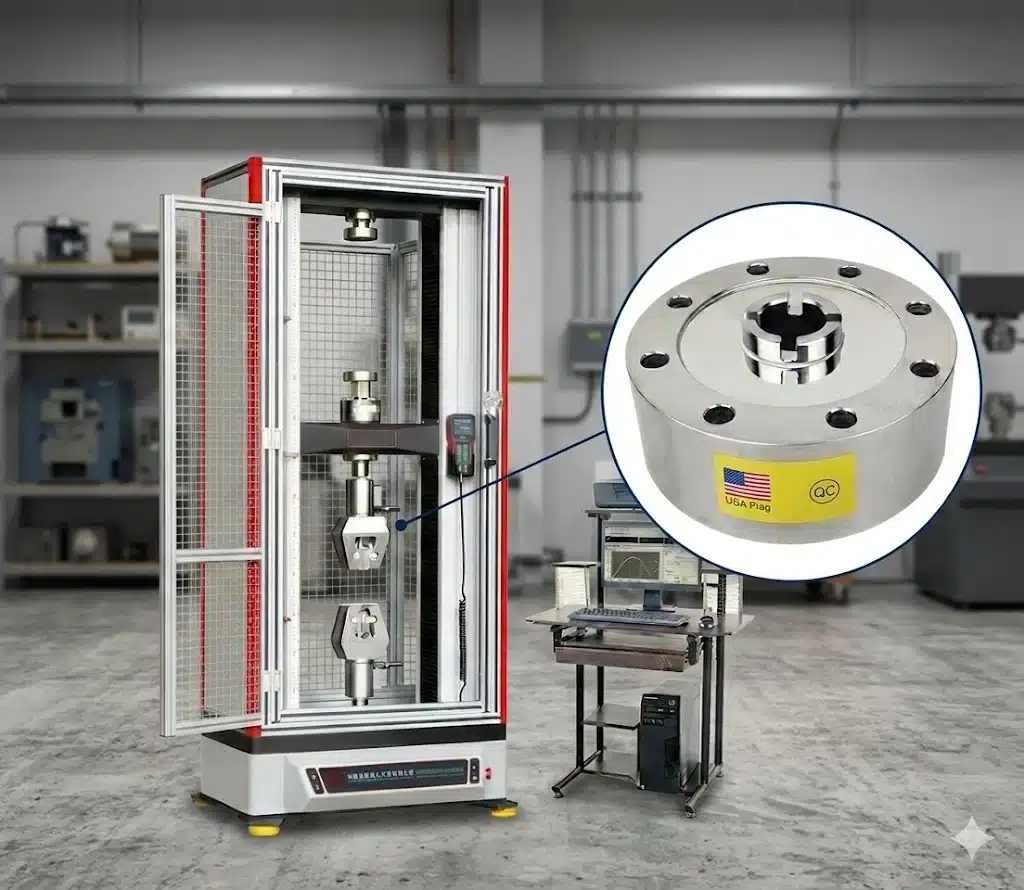
High Precision Load Cell
- Testing load accuracy: class 0.5
- Ensures stable and accurate test results
- Can be tested capacity from 50n to 1000kN
- Wide clamp range to cover different specimen size
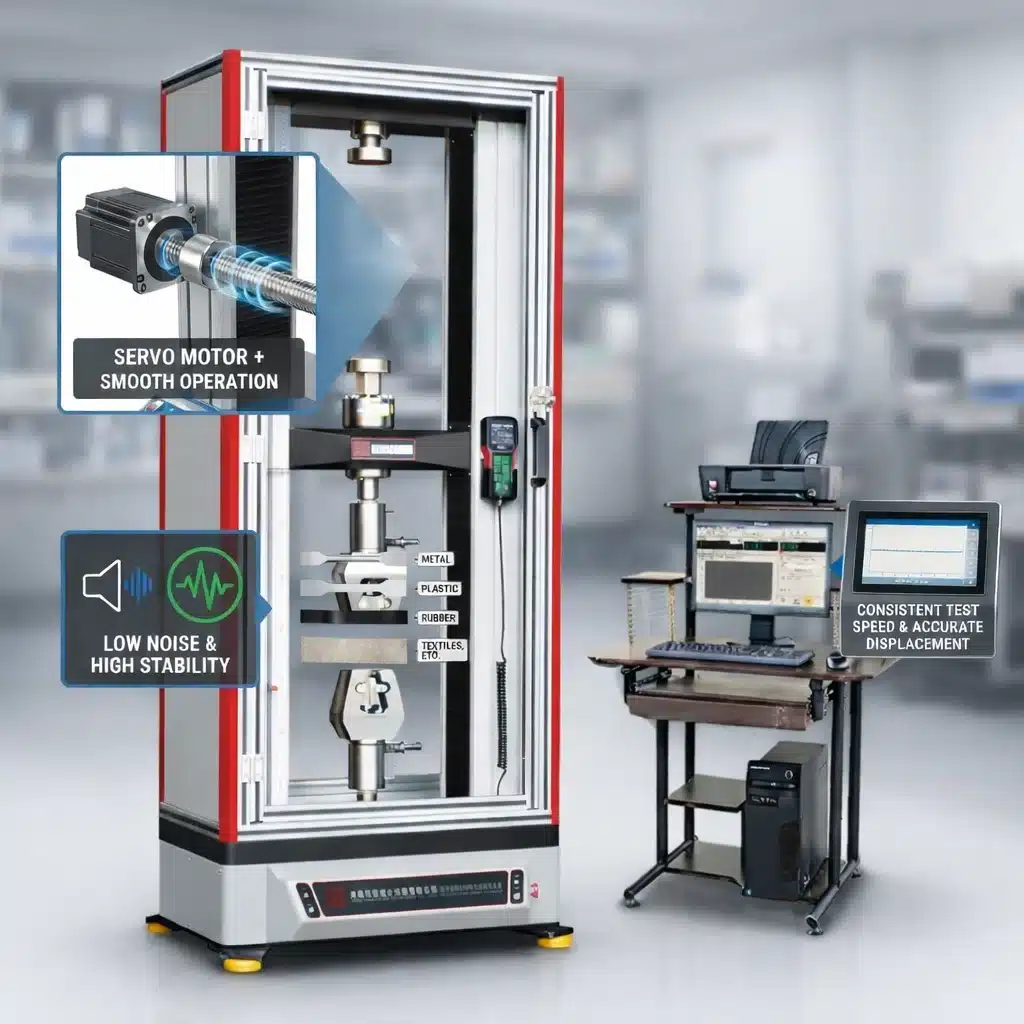
Delta Servo motor and ball screw, smooth operation
Low noise and high stability ensure consistent test speed and accurate displacement
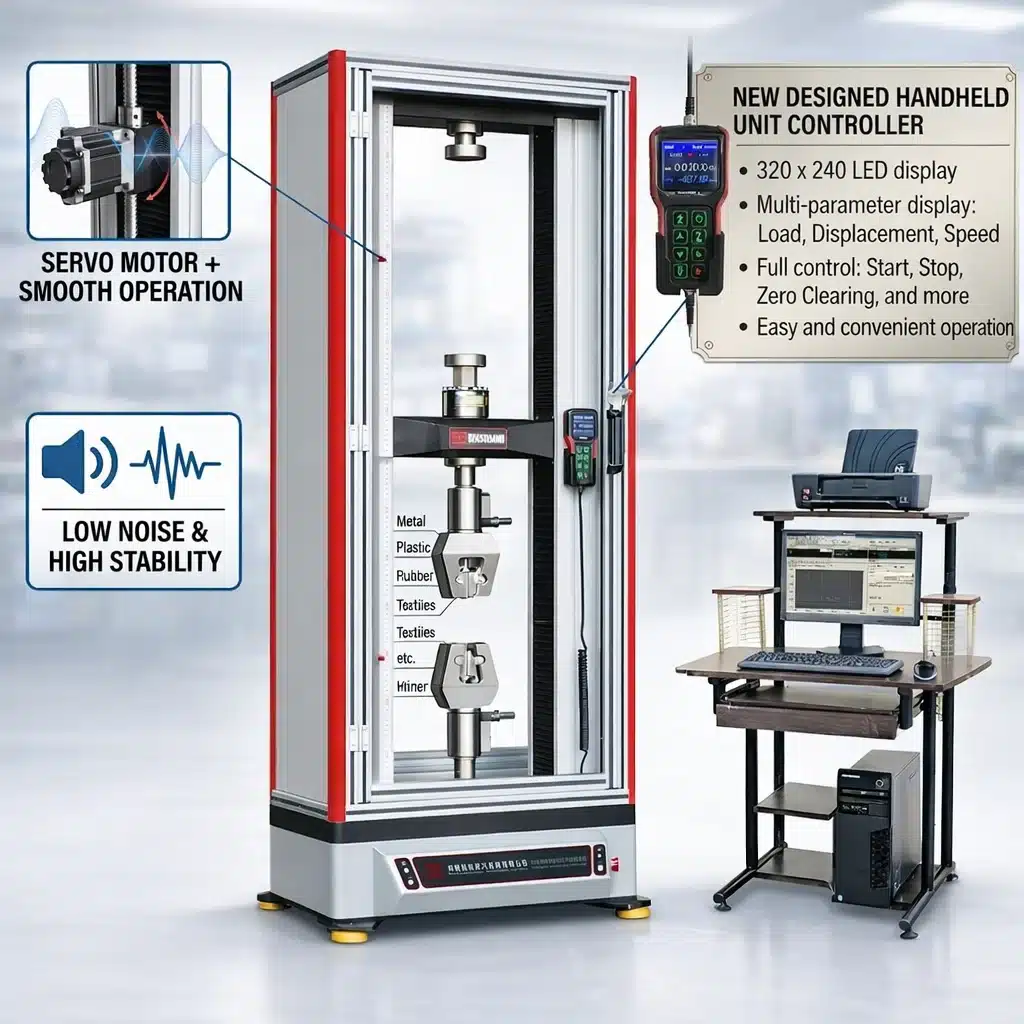
New designed Handheld Unit controller
- 320 x 240 LED display
- Can display Load, displacement, speed. Can control test start, test stop, test zero clearing and so on
- Easy and convenient operation
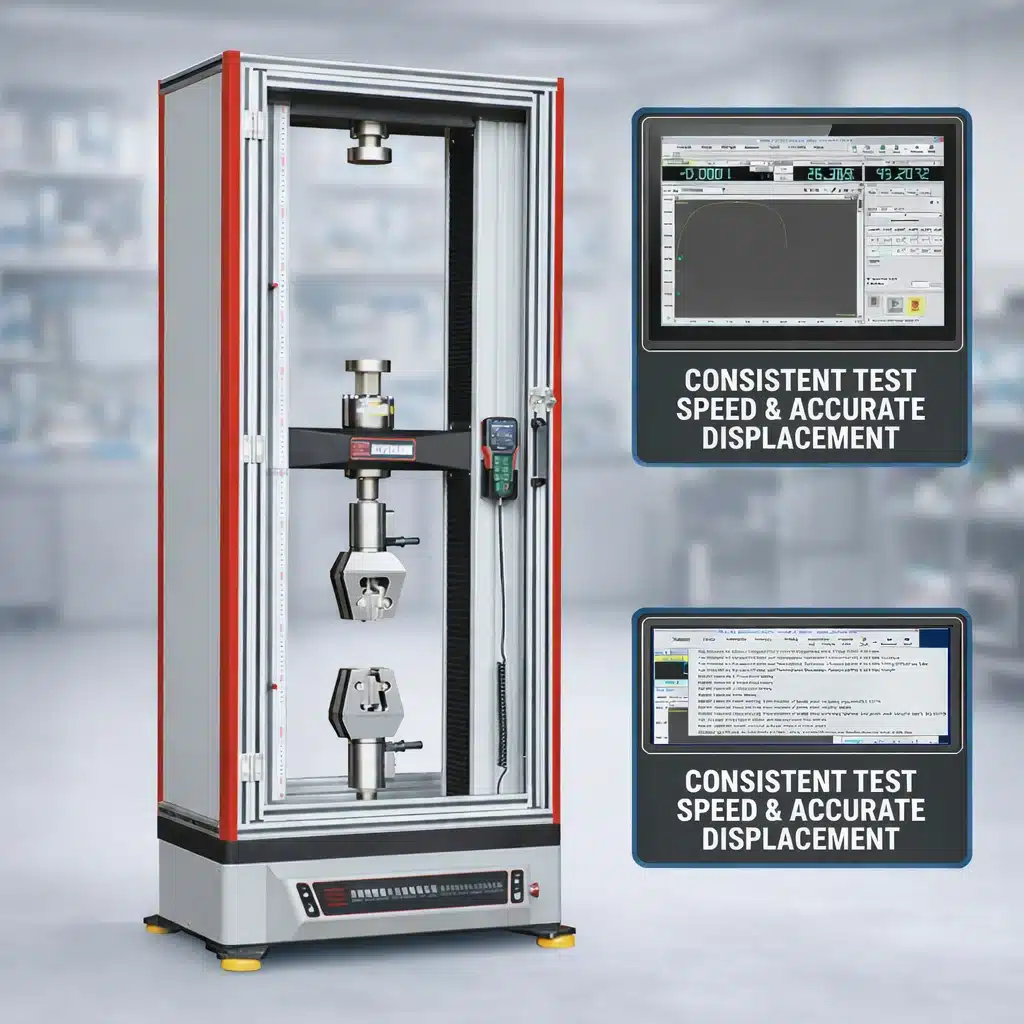
Professional materials testing software
-
1
Real-time display of force-displacement and stress-strain curves -
2
Automatically calculates yield strength, tensile strength, elongation, etc. -
3
Multilingual interface -
4
PDF/Excel report export -
5
Data storage and batch management
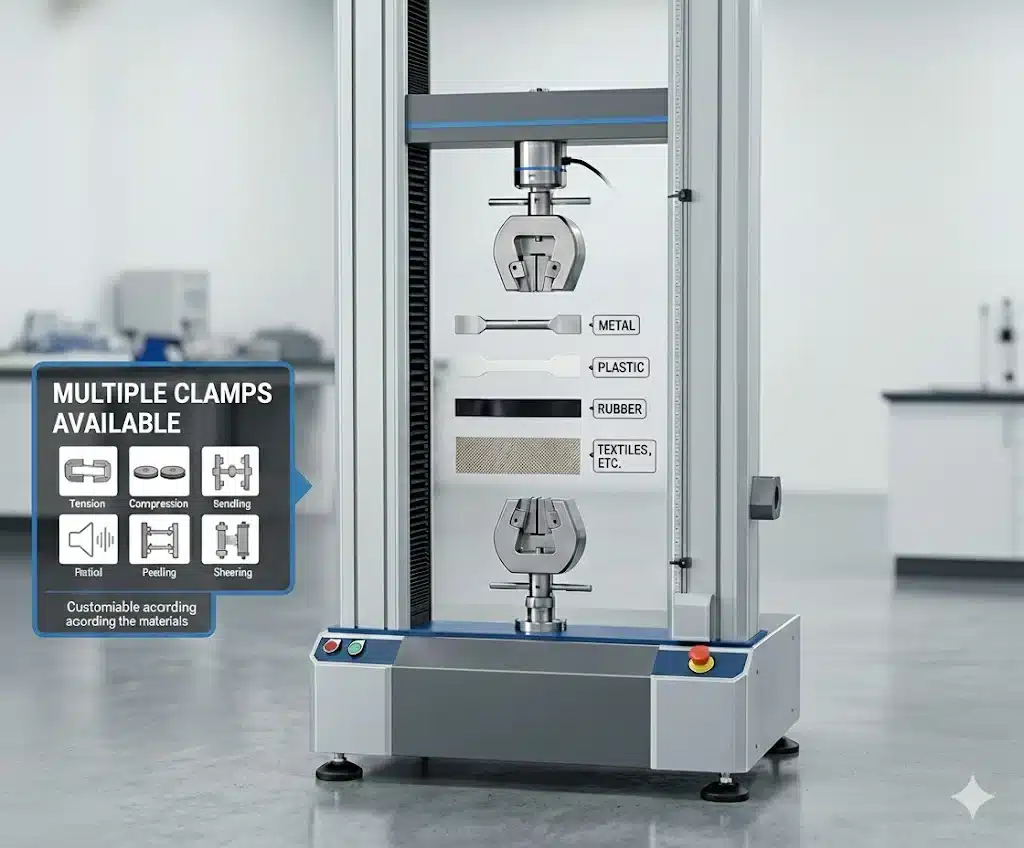
Multiple clamps available
Tension clamps, compression discs, three-point bending clamps, peeling clamps, shearing clamps, etc., can be customized according to materials.
Electronic Universal Testing Machine Model Selection

HST-HGW
HST-HGW series (Dual Space) Pipe Ring Stiffness Testing Machine, is mainly used to determine ring stiffness,ring softness and compression of thermoplastic pies having circular cross-section. It conforms to the requirements of all kinds of plastic pipes, such as structured-wall pipes,PE corrugated pipes, helically wound pipes,etc.
Test load
- 10kN, 20kN, 50kN, 100kN
Speed
- 0.001-1000 mm/min

HST-MWW
The testing machine complies with GB/T 16491-1996 (Electronic Universal Testing Machine) and meets the test methods of GB/T 17657-1999 for wood-based panels and veneered wood-based panels, as well as GB/T 4897-1992 for particleboard. Tests can also be conducted in accordance with GB, DIN, ISO, JIS, ASTM, and other international standards based on customer requirements. It is suitable for MDF, particleboard, plywood, blockboard, fiberboard, and similar materials, and can automatically test and calculate planar tensile strength, static bending strength, elastic modulus, internal bond strength, screw holding force, bonding strength, hardness, and shear properties with appropriate fixtures.
Test load
- 20kN, 50kN, 100kN, 200kN,300kN
Speed
- 0.001-1000 mm/min
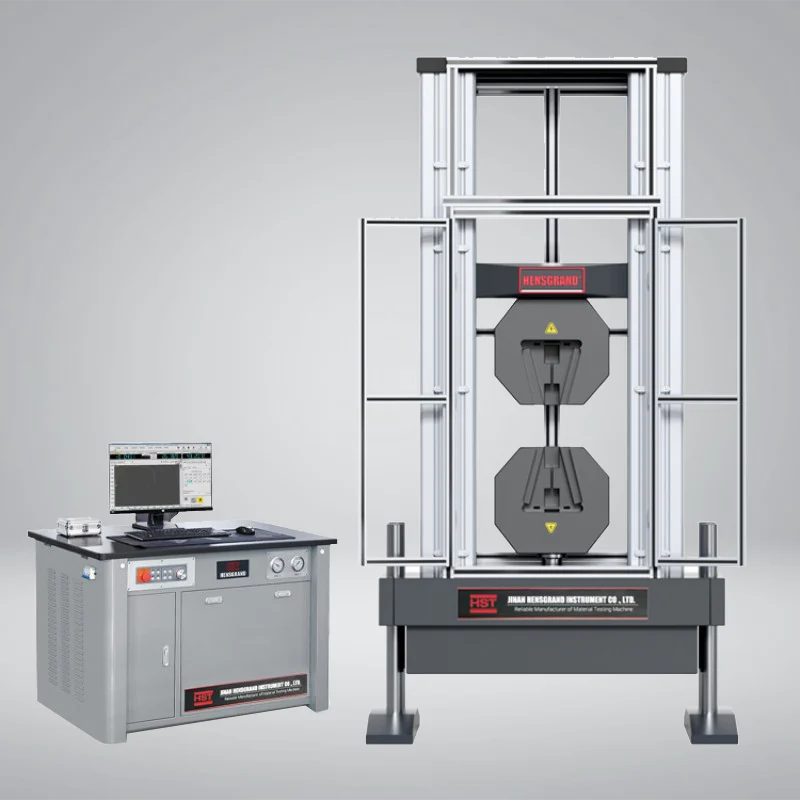
WDW-500E
Test load
- 500kN, 600kN, 1000kN
Speed
- 0.001~500mm/min

WDW-E
Test load
- 5kN, 10kN, 20kN, 50kN, 100kN,200kN, 300kN
Speed
- 0.001-1000 mm/min

HST-TLW-100E
This testing machine is mainly used to measure the tensile test and compression test of various coil springs. It can test both the spring load under a certain deformation and the spring deformation under a certain load. Mainly used in spring manufacturers, low-voltage electrical appliances, machinery, universities and research laboratories.
Standards
- Implementation standard of testing machine:JB/T 7796-2005《Tension and compression spring testing machines》
- JJF 1134-2005 《Calibration specification for special working measuring machines》
- GB/T 13634 《Calibration of dynamometers for testing on testing machines》
Test load
- 5kN, 10kN, 20kN, 50kN, 100kN
Speed
- 0.001-1000 mm/min

WDW-EG-1200
Test load
- 5kN, 10kN, 20kN, 50kN, 100kN
test temperature
- 300℃~600℃ , 300℃~1200℃ ,300℃~1600℃

WDW-EGD
Test load
- 5kN, 10kN, 20kN, 50kN, 100kN
Test temperature
- -40℃/-60℃/-70℃ -350℃
A truly universal tester
All-Temperature Hydraulic Wedge Grips for Composite Material Test
ASTM D732 Composite Material Shear Test
Bending Test
Bolt Screw Tensile Test
Ceramic Tile Bending Test
Ceramic Tiles Three Point Bending Test
Fiberglass Geogrid Tensile Test
Geotextile Top Breaking Test
High Low Temperature Tensile Test
High-Temperature LCF Test
High-Temperature Tensile Test
Packing Strap Tensile Test
Pneumatic Side Action Grips for Rubber PVC Tensile Test
Rigid Plastics Compression Test
Ring stiffness Test
Steel Mesh Test
Steel Strand and Aluminum Strand Tesile Test
tensile test of metal sheet and plastic sheet
Terminals Tensile Test
Winding Tesile Test
Application Cases of Electronic Universal Testing Machine

Customer Feedback from Australia: WDW-10E 10KN Universal Testing Machine

Customer Feedback from Thailand: WDW-5E 5KN Universal Testing Machine

Customer Feedback: WDW-E Universal Testing Machine from Czech Client

U.S. Client Feedback: WDW-E Electronic Universal Testing Machines

Australian Customer Feedback on WDW-E Electronic Universal Testing Machine

Customize WDW-100E 100KN electronic universal testing Machine for Philippines Lab
General FAQs
1.What is a tensile testing machine?
Tensile testing machines – also known as universal testing machines – are used to test the mechanical properties of materials, components, and devices.
Universal testing machines, which include electromechanical and hydraulic systems to perform static testing, including tensile, compression, bend, peel, tear, and other mechanical tests. These tests can tell us about the mechanical properties of a material or component. How strong it is, how much it can elongate/how much it stretches, how much it can compress before breaking, and how flexible it is. They can also measure the strength of an adhesive bond.
2.What are the two types of electronic universal testing machine?
Digital display model and Computer control model
3.What are the typical material and standards used in a tensile test?
The typical Materials & Standards used in a tensile test are:
Ceramics – ISO 15733, ISO 15490, ISO 17561
Composites – MIL-HDBK-17, ISO 527 (Parts 4 & 5 on FRP composites)
Elastomers & Rubber – ASTM D412, ISO 37
Metals – ASTM E8 (at room temperature, E21 (high temperature, BS EN 10002, ISO 6892
(at ambient temperature), ISO 783 (elevated temperature), ISO 15579 (at low temperature)
Paper – ASTM D828, ISO 1924 (Parts 1 & 2), ISO 3781
Plastics – ISO 527, ASTM D638
Textiles & Yarns – ASTM D76, D3822, D2256, D2653, ISO 9073 (Part 3 on nonwovens),
ISO 13934, ISO 13935
Wood – ISO 9086, 3345, 3346
4.Who uses tensile testing machines?
Any industry that makes or uses raw materials uses universal or materials testing machines to test raw materials such as plastics, metals, elastomers, and composites. These machines are also used to test finished products such as automotive components, biomedical devices, and consumer electronics.
5.What other types of testing can be performed on a universal testing machine?
Common data points rendered by universal testing machines include tensile strength, compressive strength, peel, tear, and friction properties, flexural strength, shear, etc. Tests can also be performed to common standards such as ASTM D638, ASTM D412, ISO 6892, etc.